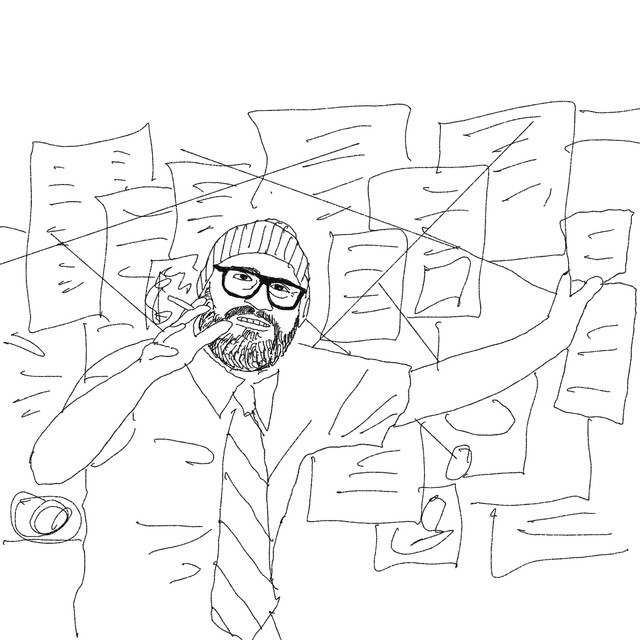
Meditation for January 1st
Not Being Smart
No matter what information a person needs or how complicated the issues may be, everyone has an opinion. Opinions have replaced intellectualism and the pursuit of knowledge. To question a person’s opinion is to be at war against their feelings and self.
No one likes to be dumb. Not being the smartest, most intelligent person in the room is the most terrifying thing in a person’s life. So an opinion becomes just as valid as a fact t even if it’s wrong.
With the Internet accessible to almost anyone, people believe they have the same access to information as experts who have studied the subject. For years, this has meant that a deli cashier has just as much knowledge of a topic as a nuclear physicist, except that the physicist bases their understanding on evidence, while the cashier shares an opinion.
Our society has decided that belief has some value. It doesn’t. There is no value in believing that God created man out of clay when it doesn’t do anything for anyone but maybe harm. Attacking a person’s belief is almost a crime, and when I say ‘attack,’ I mean asking for the facts that back that belief.
The climate hoax believers, even older adults, and the anti-vaxxer hippies believe their beliefs are legitimate and genuine. Genuinely use personal experience as a fact, something they read on a questionable website, or an email forwarded to them by either baldeagle1776@aol or purplegiraffepsychicmarigold1967@earthlink, they will even base it on just knowing it is true.
Belief and opinion have no value at all. It doesn’t serve anyone, including yourself, anything at all. In many cases, beliefs, efs, and opinions are harmful.
Knowledge is hard. It takes effort. It requires a journey. Looking at a few lines on Wikipedia, Blaze.com, or Huffithe ngton Post is not going to give you knowledge.
For example, I tried to see what percentage of GDP we, as a country, spend on science and research versus the rate at which we spend on the faith-based initiative that President George W. Bush created and then enthusiastically continued by President Barack H. Obama. While the rate of funds allocated to science and research is 2 to 3%, determining the GDP of monies allocated to various groups will require much more research. Neither administration is transparent about giving funding to faith-based Protestant programs.
So the answer isn’t easy. Beliefs and opinions are easier. Lies and guesses are the easiest.
So I could say that we spend 5% of the Gross Domestic Product (GDP) on faith-based groups. Right-wingers are up in arms about spending tax money on welfare, but feel fine about giving money to groups that perpetuate myths about the welfare programs.
But because people believe in something, they feel justified. They treat their belief as facts. They don’t have to be accountable to any truth.
Now we have a platform where everyone gets to share their opinions and beliefs with no accountability at all. “It doesn’t matter if it’s true because it’s what I feel.” We think it equalizes our knowledge, but it doesn’t. We are actually seeing how it is doing the opposite.
If you’re feeling it, then it’s not a fact, and people would rather be right than for it to be true. And that is why most people choose not to be smart.
Prayer
There’s no god, so why am I talking to myself?
Craft
How to tell if something is true.
Who said it?
Who is saying this fact? Depending on who it is, you might want to consider a few things, such as why they would say that or what supports their claim. Blogs (yes, this is a blog), podcasts (yes, I have had two), and videos don’t have to disclose their sources. Especially with social media, which banks on emotional responses, we find that they sometimes say things to get you upset and engaged. Sometimes it is spun for political reasons. While still not 100% truthful, old school print media tend to have more oversight than the wild west of the Internet. Who is saying it matters?
What evidence is provided
If you went to at least one year of college, you had to write an essay and have two primary sources listed in that annoying way. While it was annoying, you couldn’t just Google (or now AI) and write down what the Internet says instead of reading a whole book about a subject and citing it as your source; not having a primary source means it is debatable whether the facts you are providing are accurate. Academic books include pages of primary sources to support their claims. When you are reading an article about something, and even if it “feels” right, is there evidence provided? Primary sources? Books? People who were there? Experiments? If you are going to make a claim, you’d better have evidence to back that shit up! Better come corrected!
Bias
Sometimes you want to believe something to be true, so you will ignore all facts that might point otherwise. We have biases. We have beliefs that we don’t like being questioned. No one wants their foundations shaken. People we like are the good guys, and people we don’t like are the bad guys, so we have a hard time pivoting when a good guy acts badly or a bad guy acts well. We fall for things that sound good more than we fall for things that give us negative feelings. Nothing is black and white; life is complex, with shades of gray. If we believe something is true, we ought to do our due diligence and go the extra mile in our research, because our bias will make us lazy in seeking the truth.
Historical Context
We live in a time of short-form media. Short videos, memes, and 140-character quips that explain the complexities of the world we live in do us a disservice. Nothing comes from nothing. Everything is a long list of this led to that, and that led to this. There is a comedian, Brian Regan, who jokes about the saying, one thing led to another, and his joke, “Adolf Hitler was rejected as a young man in his application to art school, and one thing led to another, and the United States dropped two atomic bombs on the sovereign nation of Japan”. There’s some context missing there. Sometimes a truth will change color with a little historical context added.
Critical Thinking
Using the above tools, along with questioning assumptions, considering different viewpoints, and evaluating arguments, we can critically examine a point to ensure we cover all angles. Nothing should be taken at face value, especially if we vibe with it. Thinking isn’t easy, and it shouldn’t be. Acceptance is a form of surrender, and in the case of finding the truth, it is imprisoning yourself. Take the feelings out of the thoughts, and see if you can look at all the viewpoints and arguments for and against to see what makes sense. There is a reason people choose not to think about stuff: it sucks and can really uncomfortably trigger our emotions. Even with so much access to resources, critical thinking takes even more work to sift through the garbage to get to what is true, and doing anything complicated takes discipline.
Science
A real scientist will tell you that not everything can be explained. There are huge holes in our knowledge of the world, and some things we are relying on a strongly backed theory. What we do know has passed through rigorous testing, peer review, double-checking the first person’s work, and continuous research, allowing us to understand a lot about our world. Many of our findings have come in the last 200 years, mainly in the previous 100. Critics of science will tell you that the holes in the knowledge open up for skepticism and unscientific theories. I always say that if a scientist could prove God’s existence, they would and win a lot of accolades for doing it, but if a scientist demonstrates there is no God, they would and win a lot of accolades, but religion would lose billions of dollars. Sometimes science is used for evil, and this makes it hard for us to decipher what is true or not, especially when industries like tobacco and oil spend millions of dollars trying to fool us into believing cigarettes don’t cause cancer and that climate change isn’t man-made.
Goal
We don’t have to believe in something for it to be true.